


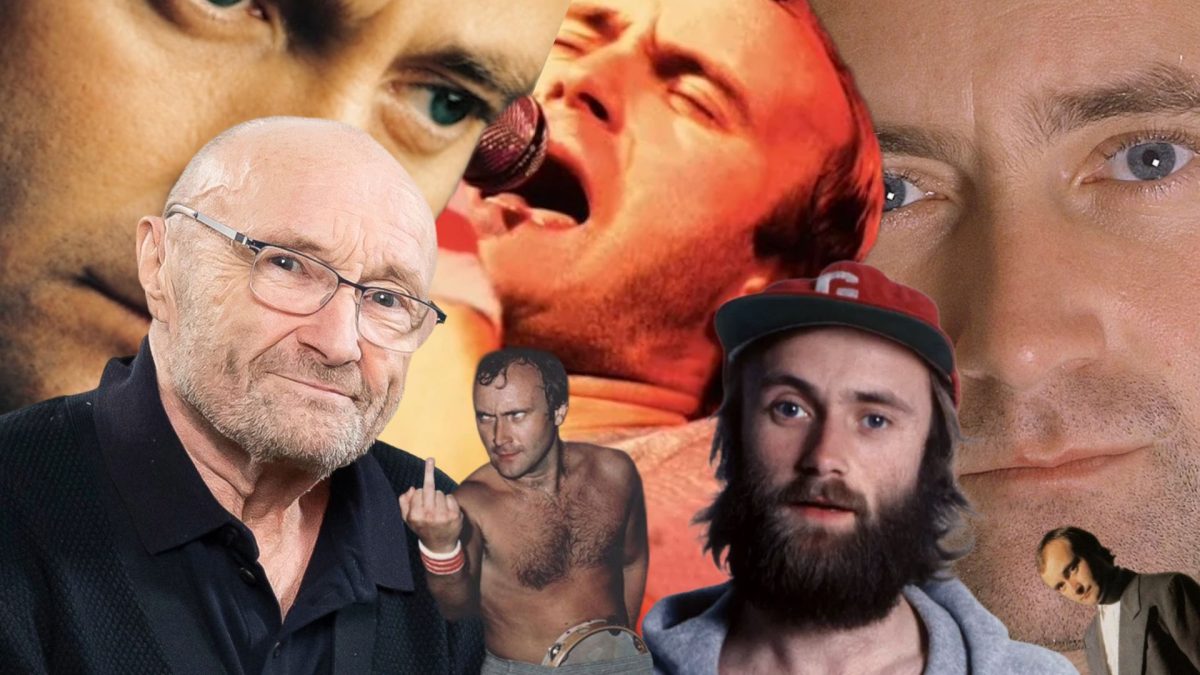
It’s 2026, and if he continues dominating the fan vote, Phil Collins will soon live in the Rock and Roll Hall of Fame for the second time — this time as a solo artist. Simultaneously, he’ll live forever in the CD drive of my dad’s 2014 Honda Fit.
I have no idea which junkyard that car is in nowadays, but if there’s any justice in this world, Genesis’ “Turn It On Again: The Hits” is still jammed in the CD player — as it was on every car ride I took between the ages of nine and 16 — and some trespassing teenagers will discover it in five years while looking for a makeout spot and find Collins encased in amber: blindingly British, balding, forever destined to sound like he’s in his early to mid-40s.
They’ll think the snare hits in “Abacab” sound like gunshots, and decide “Follow You Follow Me” is one of the prettiest things they’ve ever heard. In a vacuum, these are the ways they’ll first know Phil Collins: thunderous drummer — and, later, after singer Peter Gabriel’s departure, brilliant frontman — of prog rock greats Genesis, writer of impeccable pop songs, and of deep-cut mood pieces.
“Everybody I know that knows Phil thinks he’s an amazing person,” Brian Coombes, a music producer and owner of Pittsfield, N.H.’s Rocking Horse Studio who has collaborated with multiple members of Genesis, told The Beacon. “He’s a loyal-to-a-fault, hardworking, loves-everybody person.”
But when the sun rises, and those teens steal back home and climb through their windows once more, will they know the world turned on him when he accidentally became bigger than his band? Will they know that in 1981, less than one year after Genesis’ “Duke” hit No.1 on the UK Album charts, Collins’ debut solo album, “Face Value,” came out, and he alone would be accused of undermining the artistic integrity of all music for the next decade?
“It must have felt like I was in their faces all of the time,” Collins told Music Week in 2010. “It would be Genesis album, Genesis tour, Phil Collins album, Phil Collins tour, Phil Collins produces somebody else —”
I’ll come out and say it: Collins is, in my humble opinion, one of the greatest musicians of any era in popular music — and the victim of more unfair abuse than any other solo musician in recording history. Even with a rare resumé as a simultaneous singer and drummer, 150 million records sold worldwide, and a tribute show that was, coincidentally, performed Wednesday night at the Emerson Colonial Theatre, a large segment of the modern population knows Collins’ biggest songs as punchlines:
easy-to-pick-apart ballads about an uncool guy pining for a cool woman or noticing societal injustice.
Oh, the humanity.
Take “Sussudio,” a silly pop hit about a crush, which has been retrospectively described by The Village Voice’s Michael Musto as so “insidious and evil” that it “could have been the theme song for the Third Reich.” Or “Another Day in Paradise,” a Grammy Record of the Year winner about homelessness that the BBC’s David Sheppard used as an example of Collins “painting the bull’s-eye on his own forehead” for critics.
“No other artist epitomises the ‘80s quite like Phil Collins,” wrote The Guardian’s Tom Cox in 2000. “In a way, he is the ‘80s: slick, capitalist, compromised.”
When people discuss music defining a generation, they usually do it with rosy-cheeked fondness; when critics invoke Collins’ stranglehold on ‘80s MTV and radio play, they blame him for having an irreversibly soft, adult contemporary influence on Genesis’ later albums, and lament the syrupy overexposure of his solo material. David Bowie called his own ‘80s artistic nadir, and the worst of his pop projects, his “Phil Collins years.” Others, like Cox, labelled Collins as the schmaltzy dude who did the “Tarzan” (1999) soundtrack and ruined pop music with his “plumber” look, and Oasis guitarist Noel Gallagher infamously said he wanted Collins’ severed head in his fridge.
Some, like Collins himself, simply thought he was “annoying.”
Of course, the fallacy in all of this is that Collins is a normal guy, and therefore an easy target, whose only sin is his willingness to be in on his own cheesiness: a mortal sin in the image-obsessed world of popular music that an induction into the Rock Hall could go a long way towards mending.
Think ‘ole Phil’s a cornball? Well, when widely agreed upon genius Paul McCartney left the Beatles, his second solo effort, “Ram,” was dismissed as a failure for its corny eclecticism and cheery “screw you” attitude to all things John Lennon and “Plastic Ono Band.” Nowadays, it’s regarded as a stone-cold rock classic — and Lennon’s freakout ballads, which captured widespread acclaim during that same period, sound primitive.
A more recent example lies with popstar Benson Boone, who’s been eviscerated by every internet troll for singing happy songs and perfecting the art of the backflip. Do I admire him? Not particularly. Do I defend his right to be a silly little guy with a silly little mustache?
You bet your sorry, hating ass I do.
Collins may have written a lot of bright tunes, but it took more than bumbling, centrist craftsmanship to sell as many albums as he did. Within the trappings, or lack thereof, of his unassuming working class charm was a willingness to be lyrically political but not impersonal, and to accept life’s toughest beatings and move on. Take “Face Value,” which came as a result of his first divorce, and “Both Sides,” which came as a result of his second divorce, and on which he played every instrument. His voice was whiny enough to get your attention, haunting enough to intrigue you, and sincere enough to enchant two stadiums’ worth of Live Aid supporters.
“[Collins] is just as goofy as anybody else and he’s got a sense of humor about it,” said Ken West, the brand manager for Emerson’s 88.9 WERS radio station, who grew up during the height of Collins’ mainstream success. “I think we all need that because really, in essence, he’s being authentic. He’s being real and he’s connecting.”
Accuse him of sounding “of his time” due to his reliance on large, punchy, synthetic-sounding drums? Fine. Just know he was the pioneer that popularized the mainstream sound of those synthetic drums in the first place — a groundbreaking technique known as “gated reverb.”
“[Gated reverb] was the sound of the ‘80s,” said Coombes. “I hear it on records to this day. Maybe it’s [because] a couple of generations passed, [but] now, some young producers may be using that technique [and] not know where it came from.”
Audio engineer Hugh Padgham discovered the sound of “gated reverb” accidentally while he and Collins were working on the drums for Gabriel’s third album. One year later, Collins used it to blow up the joint on “In the Air Tonight”’s iconic tom fill, kicking off a decade of reverb-drenched percussion on classics such as Kate Bush’s “Running Up That Hill,” Tears For Fears’ “Everybody Wants to Rule the World,” and Prince’s “Purple Rain.”
Still, with Collins, the reverb coincided with an innate feel that fused jazz with prog rock technicality, turning every groove he played into a song of its own. As a drummer, I can say with certainty that, like some indescribably delicious smell punching through a busy marketplace, Collins’ pocket on his Philip Bailey duet “Easy Lover” — one of my all-time favorite songs — is an umami marvel: beefy, danceable, and downright inspirational to every timekeeper alive.
“I think he’s one of the best rock drummers in music history,” said Coombes. “And I think he’s underappreciated for that.”
I can only hope, like so many admirers, that this Rock Hall opportunity will not only dispel the negativity that’s followed Collins around like a clingy specter his entire career, but finally illuminate his insane musical gifts for a world seemingly turned against them by force. He’s 75 now — more than 50 years since he first debuted with Genesis — and a slew of serious health problems have forced his retirement from drumming and live performance. His last album of original solo material, “Testify,” came out in 2002 and was, according to the fine folks over at Wikipedia, “panned.”
This is the monumental ending his legacy deserves in the public sphere: not just as a Reagan-era hitmaker, but as a musician’s musician. And yet, even if he crosses that stage to rapturous applause, and we all suddenly act like we uplifted him the entire time, he’ll always have a residency in that Honda Fit, where, to me, he isn’t anything other than Phil.
The guy who’s voice skips around track 11. The bloke who sounds nice to my ears.



This is a wonderful opinion article! With Phil Collins, everything is coming full-circle, and appreciation for his music is especially highlighted in recent years. The Eight-Time Grammy Award Winner (including Songwriter’s Hall of Fame Inductee/John Mercer Award Winner), has also garnered six Brit Awards, an Academy Award, Two Golden Globes, and is a Four Time Billboard Award Winner. He’s only one of three artists (including Paul McCartney and Michael Jackson) to sell over 100 million records both with a band (Genesis) and as a solo artist. What more, Phil Collins has more top 40 hits than any other artist during the 80’s. Overall, the entirety of his career projects has seen Collins sell 375 Million Albums/Records. Wow. How he has not been inducted before now is a travesty, though, the fact he is now getting due recognition, is leading the fan votes, is a testament to his long enduring impact not of just this era, but all eras for his music, musical contributions. A tribute album by various hip hop, R&B, and rap artists was released in 2003 called Urban Renewal.