

If you haven’t flipped on your televisions, accidentally switched your car stereo to FM radio, or walked past a construction site lately, here’s a shocking development: The New England Patriots, led by boy-genius quarterback Drake Maye and head coach Mike Vrabel, are once again the pride of Boston.
If you’d told me nine weeks ago that this roster—which spent the last two seasons going a combined 8-26—would not only be sitting atop the AFC East at 7-2, but would be playing in such inspirational form that they welcomed new scandals reminiscent of their glory days, I’d have laughed at you and stolen your lunch. And yet, following the Pats’ 24-23 victory over the Atlanta Falcons during Week 9, Falcons head coach Raheem Morris attributed a late-game intentional grounding penalty on quarterback Michael Penix Jr. to good ole fashioned New England dark magic:
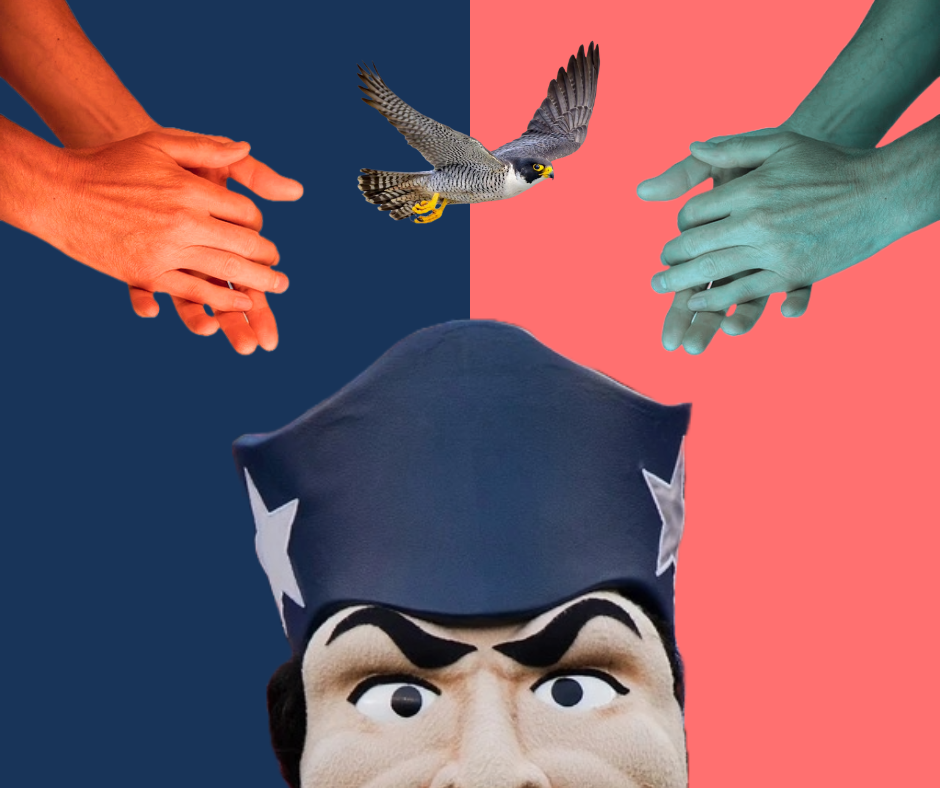
Apparently somebody clapped, and that blew up everything.
“They did a nice job, they simulated a snap,” Morris said in a postgame press conference. “The ball came early, was snapped early … was on that snap where we got the intentional grounding. Nice job by those guys. Great situational football. Great play.”
In hindsight, most seem to agree that this “snap simulation”—a fancy term for the opposing defense tricking the offense’s center into snapping the ball early through “disconcerting signals” (in this case, clapping)—likely didn’t affect the play, and that Morris’s sound bite was one of misplaced bitterness.
Yet this didn’t stop the Pats from briefly entering into their third “Gate” to date: “Clapgate.”
Dun, dun, dun!
For the first two decades of the 21st century, New England, in employing Tom Brady (a Greek god) as quarterback and Bill Belichick (a curmudgeonly genius) as head coach, unleashed a wave of such sustained dominance on the NFL that it produced not only six Super Bowl rings and a borderline-okay comedy flick, but a legion of cheating accusations.
Paradoxically, instead of affecting the team in a sustained, negative way, scrutiny always stood as a bizarre marker of success during the Brady-Belichick years.
“In the arena of stats and measurables, the New England Patriots are one of the best teams in the post-merger NFL,” wrote Boston.com’s Jerard Fagerberg in 2015. “However, they’re superlative in the realm of gossip and scandal.”
Take the giant elephant in the room that started the Brady-Belichick era in the first place: When, in the 2001 AFC Divisional Game, the Pats miraculously skirted defeat through the “Tuck Rule,” a little-known rule that turned a Tom Brady fumble into an incomplete pass, and into a win. Following their franchise-first victory in that season’s Super Bowl, the team rapidly ascended into the well-oiled machine that terrorized opposing teams and their fans for an entire generation.
“Tom Brady owes me his house,” joked Charles Woodson, the Oakland Raiders defender who forced the “Tuck Rule” play in 2014. “I’m the reason why he’s married to who he’s married to. Everything. Because they overturned that call. Tom, come on now, fess up, it was a fumble. It’s still a fumble.”
In 2007, during the same season that saw the Patriots accused of illegally videotaping New York Jet coaching signals in “Spygate,” the team finished the regular season undefeated—becoming the second squad in the Super Bowl era to do so. They ultimately lost that year’s Super Bowl, yet even with the stripping of a 2008 draft pick and hefty fines for both the organization and Belichick, they returned to the The Big Game four seasons later (they lost that one too, but you get the point).
The dancing didn’t stop there. In 2015, after Tom Brady was accused of gaining a throwing advantage by illegally deflating footballs, the team went on to appear in Super Bowl XLIX (49), this time defeating the Seattle Seahawks in one of the most iconic endings in recent memory. Two seasons later, a thorough investigation (witch hunt) led by NFL commissioner Roger Goodell resulted in Brady serving a four-game suspension for “Deflategate,” though the Pats still managed to erase a 28-3 deficit against the Atlanta Falcons to win Super Bowl LI (51).
“The two gentlemen we have here have set new bars across the league,” said Goodell at the Super Bowl LI MVP trophy presentation.
As Goodell handed the statue to Tom Brady—the man he’d been in a year-long battle with over ball air pressure—and stood beside Bill Belichick—the man he indirectly fined $500,000 in the wake of Spygate—one thing became abundantly clear: You couldn’t kill the Patriots, but because of a glitch in the football matrix, you sure could empower them.
It was this dissonance that made the New England Patriots the “Evil Empire” of the NFL, and with it, birthed a generation of passionate haters that preyed on the franchise’s downfall like they would a corrupt politician—or so you’d hope they would. I can’t say I blame them; we’re conditioned to root for underdogs, and lack of parity gets boring. Heck, I hate the Kansas City Chiefs—New England’s heir apparent—with a flaming passion reminiscent of an evil firepit, and if it came out that they’d been cheating, I’d request a personal audience with Patrick Mahomes, if only to repeatedly kick him in the groin.
However, I’d argue that Goodell and the NFL, in attempting to begin the Patriots’ demise with a steady stream of conspiratorial inquiries, fines, and suspensions, have always been the strongest haters.
“I’m not sure if [Goodell] realizes what he’s doing is brilliant, but what he’s doing is brilliant because he’s made the NFL relevant 365 [days] by having these outrageous, ridiculous witch hunts,” Cleveland Browns offensive lineman Joe Thomas said of “Deflategate” in 2015. “It’s made the game more popular than ever and it’s become so much more of an entertainment business and it’s making so much money.”
In a strange way, Raheem Morris’s comments, which he’s since walked back, are incredibly heartwarming, if only because they evoke simpler, more familiar times—those prior to Tom Brady leaving our sorry behinds for Tampa Bay in 2020. No, the Patriots didn’t intentionally throw off Michael Penix Jr. by clapping, and like “Deflategate,” it’s amusing to think that something so simple and meaningless could cause such outrage.
The very fact that it’s causing outrage means that the Patriots are once again relevant enough—and scary enough—to draw attention. Whether or not this translates to Super Bowl success, knowing what the history books say about this team and scandals, I’d call a 7-2 start and a healthy dose of fear a resounding success.