

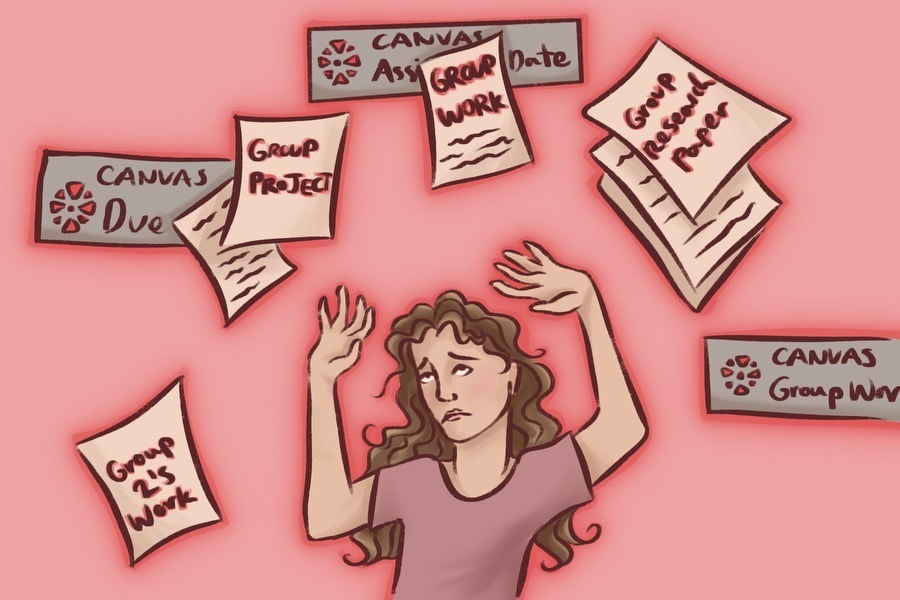
It’s a tale as old as time: you’re assigned to a group project worth a hefty percentage of your final grade, and none of your groupmates seem to be pulling their weight. When the group was first formed, everyone appeared to be on the same page about sharing responsibilities. However, as the deadline neared, one member disappeared and another barely contributed, leaving you to take on all the work yourself.
For scholarship students like me, this is not merely an annoying college experience, but rather a source of real anxiety that is mentally taxing. If your ability to afford school depends on maintaining a certain GPA, every assignment’s stakes feel dangerously high. When assigned a group project, this worry intensifies, as it feels like the fate of one’s scholarship status is in their groupmates’ hands.
At Emerson, most merit scholarships require at least a 3.0 GPA to renew each year. Sure, one bad group grade may not significantly tank a GPA, but a series of them can. Consequently, the cost of letting the actions of your lesser-engaged groupmates slide results in not just a bad grade—it’s detrimental to your ability to stay in school.
One part of group work that is so frustrating for scholarship students is the lack of control—we’re used to carrying the responsibility of maintaining good grades. Sharing that charge with random classmates is hard to handle, and it is here that the strife of group work arises: some members do not pull their weight, work styles clash, and resentment grows.
David Hall and Simone Buzwell, both researchers at Swinburne University of Technology, refer to these individuals who take on lesser roles in group work as “free-riders.” These students suddenly go silent in the group chat, stop attending classes, contribute little to the assignment in comparison to other members, or feel compelled to participate less due to a fear of not meeting the standard of the assignment or their peers. Whatever their reasoning, free-riding causes fellow group members to strongly dislike group work, with researcher Raksmey Chan finding 80% of surveyed students felt increasing frustration and anger towards group work due to this behavior.
When I first came to Emerson, I was especially surprised by my classmates’ free-riding, as I naively assumed everyone was as motivated as I was. However, what shocked me more was my professors repeatedly assigning group work, knowing the anguish it causes, and insisting that because collaboration will be an everyday part of our future careers, it’s crucial to learn how to work in teams. Unfortunately, this is partly true. Many majors here, such as filmmaking and journalism, rely heavily on teamwork.
However, there’s an important difference between working in teams in college and in the workplace. Bosses hold employees accountable for chronic underperformance and for skipping meetings. In the classroom, these same free-riding behaviors are instead dismissed by professors.
According to James Lang, an education writer and author of “Cheating Lessons and Small Teaching,” students notice these disparities in real-world practice and group projects, often feeling discouraged as professors fail to assist them. In his article for The Chronicle of Higher Education, Lang writes that students dislike group projects because their instructors rarely teach the collaboration skills necessary for success—a dysfunctional system he refers to as “pedagogical malpractice.” In this way, professors are doing a disservice to their students by leaving them unprepared for uneven contributions and groupmate conflict, ultimately making them—especially scholarship students—scramble to salvage their grade. Considering this, it’s no wonder so many students feel group work is unproductive; it has never really worked in the ways teachers think it does.
Furthermore, this lack of instructor support during group work becomes even more damning when they downplay grading concerns. Most recently, several of my professors have told me not to worry about grades, and that employers don’t care about GPAs. These types of statements ignore the reality that some students need to care about their grades because their scholarships depend on them. Whether they intend to or not, these professors are implying it’s okay not to put in the effort to submit quality work—whether it’s for a grade or not—which only contributes to the problem of group work even more, leaving scholarship students feeling hopeless as their teachers’ comments encourage their group mates to put in less effort.
While group work is not going away anytime soon, there are ways professors can help ease students’ worries. For one, they can incorporate peer evaluations and mid-project check-ins that actually affect grades while also setting clear consequences for nonparticipation. Or, even more simply, instructors can take students’ complaints of unequal efforts and academic or financial worries seriously.
The reality is that group work can certainly teach students teamwork, but that is much more attainable when the professor is also part of that team. If professors truly care about their students’ mental health, they must help prepare students for collaborative work, redesign their group projects, and hold free-riders accountable. Until then, students like me have no choice but to brace for disaster when our professor announces a group assignment.