


What happens when one of the East’s and one of the West’s most famous heroines are given a second chance at life, by each other’s sides, in the same world?
Vermilion Theater’s production of “Juliet and Jul-Yingtai,” which played at the Strand Theatre in Dorchester Jan. 15-17, brings together Shakespeare’s classic “Romeo and Juliet” and the classic Chinese folktale “Butterfly Lovers.” The play premiered at the Yale Crescent Underground Theater in Connecticut last April with a sold out show.
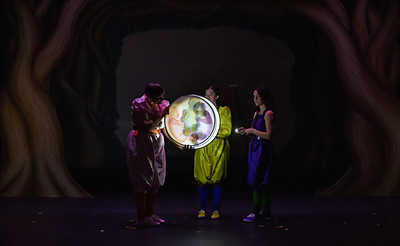
Performed in both English and Mandarin with English subtitles on a screen above the stage, the show follows two heroines — Juliet (Wisteria Deng) from Shakespeare’s play, and Jul-Yingtai, (Aiwen Chen), a woman who disguises herself as a man to attend classes and falls in love with a fellow classmate, from “Butterfly Lovers.” The setting begins in purgatory, where the characters decide if they want to live another life or move on to the afterlife. In the reincarnated lives that they end up choosing, the two women grapple with the idea of letting go of their past memories in order to try again.
“It’s about two women pushing against the fate that was assigned to them by the playwright — the storyteller — and taking over the mic to write their own story,” said co-director, artistic director, and Juliet actress Wisteria Deng in an interview with The Beacon.
While both “Romeo and Juliet” and “Butterfly Lovers” center on romantic love, the relationship between the two women in Juliet and Jul-Yingtai is intentionally left up to audience interpretation.
“Love [in this story] is broadly defined,” Deng said. “I think the audience members will walk away each having their own answer, whether or not it’s romantic love, whether or not it’s sisterhood, or a protective kind of love.”
The all-female creative team and cast focused on womanhood, the question of who defines what it means to be a woman, and what a woman’s fate becomes in the world’s most popular stories.
“There is so much that is universal regardless of the culture,” Deng said. “We see that in the Western archetypes and stereotypes, and we see that in Chinese culture and Chinese mythologies.”
The purgatory-like setting that the characters return to each time they die allows for a deeper exploration of these themes, particularly through the presence of one of the few goddesses in Chinese mythology — Meng-po, played by Zhimeng Li — who rules over the realm. The show examines death through a non-Western lens, challenging dominant cultural narratives regarding the idea of life after death.
“For me, a lot of the conception around death is totally Western,” said Xinran Li, videographer and Vermilion community resident artist. “I almost lost most knowledge about that. To think about reincarnation, or even the idea of temporality, is Western for me.”
The play does not pose an argument between the two cultures’ views of death, but a conversation which allows the audience to examine it through a cross-cultural lens. This kind of cultural exchange and intersectionality is woven throughout the production, demonstrating that, no matter where they originate, stories can share universal themes and resonate across cultures.
“But in this play we talk about the feelings we carry all the time, and the memories, and it’s very different from the Western idea of death,” said Li.
Inspiration for the play struck when the team noticed the parallels between the story of Juliet and Jul-Yingtai; the two characters both chase a forbidden romance and choose to take their lives over love. But the writers did not want this ending for the two women. Instead, they allowed them to break out of their gender roles and seek autonomy instead of dying for the sake of a man. This version of their story gives them the power to choose their own fate.
The team’s motivation for blending cultures and narratives from different belief systems is to create a cross-cultural understanding. The production is meant to bridge perceived differences and highlight the common ground of emotion and experience between two cultures.
“I think cross-culture exposure is something that gives you the motivation to feel what other people are feeling, and to realize that ‘they are not that different from me,’” said Li. “Once you have that willingness [to learn about other cultures], you will learn that a lot of things are, deep down, shared.”