

At exactly 7 p.m. on Jan. 23, I took stock of my surroundings: Starfished atop my comforter — or as much as one can be on a twin XL bed — with my mostly unpacked suitcase clinging onto the last vestiges of a visit home, ignoring my open laptop displaying some toilsome personal branding assignment.
When the opening synth of Harry Styles’ new single “Aperture” pulsed through my Alexa, all those petty tribulations faded away. In their place rose new, more nostalgic surroundings.
Me, 15-years-old, my overly staticky AirPods buzzing out the trumpets of “Fine Line.” Me, 12- years-old, my wired headphones — right ear always a little louder than the left — plugged into a lightning to aux adapter cable to watch the “Sign of the Times” music video without my brothers’ uninvited commentary.
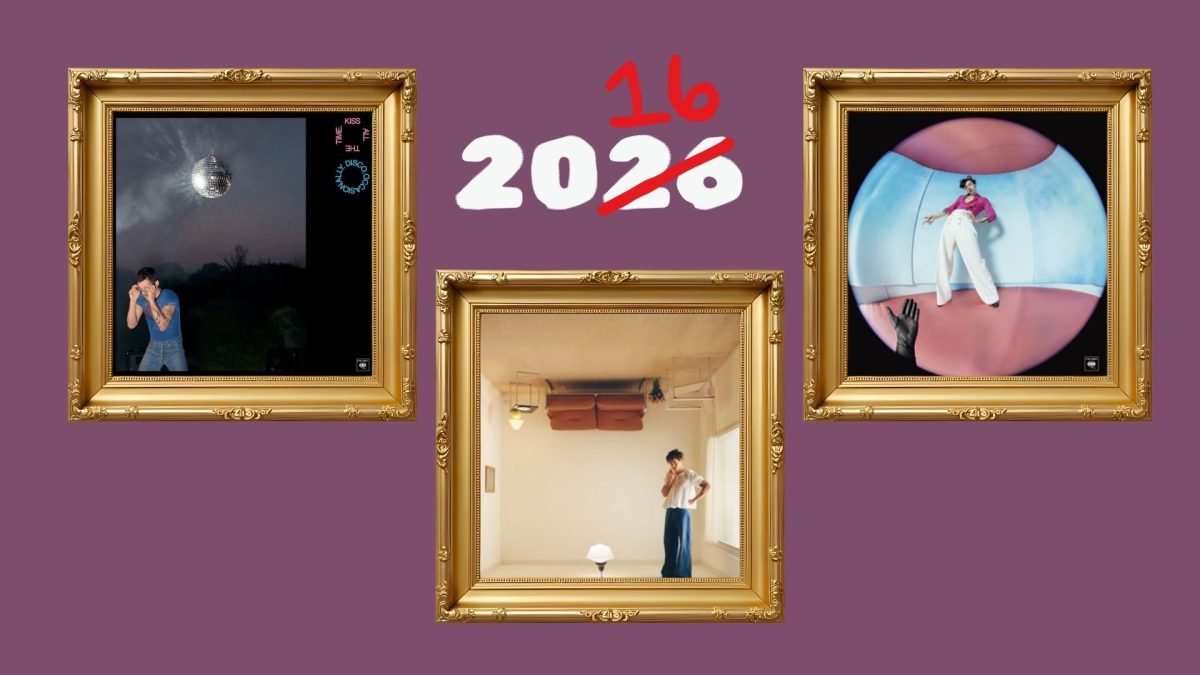
Nostalgia keeps the younger me alive. It allows me to step back from the insecurity of the present, from the turmoil of life in the United States in 2026, and retreat into moments that felt warmer and safer. I’m not the only one. When the clock struck midnight on New Year’s, 2016 became all the rage.
It’s impossible to open your social media platform of choice and avoid a #throwback to #2016 on the timeline. And how could we not throw it back to 2016? One Direction was still together, we were going to the movies to see “Zootopia,” and “Cake by the Ocean” and “Hotline Bling” were on the radio (not that I ever heard them on the radio; I lived in Mongolia at the time).
Harry Styles, Zara Larsson’s “Lush Life,” Pats in the Super Bowl: Much of what’s trending right now had its moment 10 years ago.
But if we step back into 2016, remembering only Buzzfeed quizzes and Marvel movies and dorky photos, we might forget what happens next: Donald Trump is elected the 45th president of the United States. His campaign, with a focus on restoring a whitewashed and revisionist version of American history to its former glory, weaponized nostalgia. The political consequences of that moment have fundamentally changed the course of U.S. politics and culture, impacting both international relations and domestic political polarization in ways that still feel irreparable.
Ten years later, at the 2026 World Economic Forum in Davos, Switzerland, Canadian Prime Minister Mark Carney stood onstage in front of the global economic elite and rejected nostalgia.
Carney argued that Canada can no longer rely on postwar assumptions that allowed it, and other middle powers, to coast on institutional goodwill and historical precedent for stability. Carney said it himself: “We are in the midst of a rupture, not a transition.” The old order is over and there is no way to simply ignore that and focus on what used to be good. Looking backward for answers only serves to continuously distort reality, fracturing us further.
There is no other option. We have to move forward.
That clarity at such a prominent level has to serve as a line in the sand. Our fixation on 2016 speaks less to the year itself and more to what it felt like to be young, to be hopeful, and to believe that progress was inevitable. But we cannot tie our hope for progress to the past. This nostalgia only speaks to some of us; for others, 2016 being the beginning of this country’s descent into conservatism further corrodes memories of a year already marred by loss. We must reject nostalgia as a strategy.
The future cannot be built to emulate the past. We must learn from it and move on. We can bring back music. We can bring back fashion and trends. But we cannot bring back our refusal to see clearly. Nostalgia has its moments; we are allowed to revel in our own memories, as well as art and experiences that move us. But we cannot linger only on how moments felt enough to forget to ask hard questions, or refuse to confront a history that continues to harm our lives. Revisiting the past without accountability offers no clarity and no way forward.
One day, a new lead single off a Harry Styles album will drop, and I’ll be catapulted back to the moment “Aperture” released. I’ll remember dozing atop the warm comforter of my bed, fairy lights glowing around the room, Alexa blaring loud enough for the whole Little Building fifth floor to hear the new release. Will I remember that Alex Pretti was shot by ICE the next day?