


When I was a little girl, I loved my father so much I wanted to be just like him. I remember curling up on the couch next to him at 8 o’clock on Saturday nights to watch “Columbo,” the how-dunnit show that became our weekly tradition. During commercials, I would take out my pen and paper and we would go over all the clues the murderer had left behind, trying to see if we could beat Detective Columbo at figuring it out. After I helped my mother make breakfast, I would be on my Dad’s boat, his pride and joy, helping him in the engine room, holding the flashlight for him as he tried to find the leak — again. Before school every morning, Dad and I would park at my high school and talk about the Bible study prompt for that day. More often than not, our conversations ran overtime, and I would risk being late to class for just a few extra minutes with Dad.
I wanted him to be proud of me, or “well pleased,” since he refused to ever use that word because God never used it for Jesus in the Bible. I spent as much time with him as I could, building, talking, and fixing things. My mother and I share our Haitian practicality, our tendency to engage in the things that were tangible and useful in our daily lives. But Dad and I shared our love of discussing the philosophical, one of the things that mattered most to me and still does to this day. When I was a little girl, I was my father’s daughter, through and through.
Our connection, which had stayed strong throughout my childhood, started to fracture after I turned 16. My APUSH class went deep into issues that I had never really thought much about before, like slavery and civil rights, and learning more about how America’s founding fathers were slave owners and how Malcolm X wasn’t really the “antithesis” to Dr. King. When I spoke with my teacher, who happened to be very liberal, he challenged me to question the beliefs I had held my entire life. Because I respected my teacher — but mostly just wanted to prove him wrong — I did start rethinking some of the ideology that had influenced me since I was small.
Through this reconsideration, I realized I was wrong about a lot of things, particularly how racism is truly a systemic issue; just because I was privileged enough to not be affected by the broken system, it didn’t mean that others with the same Black skin as mine weren’t being affected. This meant my Dad, my central influence, was wrong as well. Having to tear down and reanalyze everything that I’d believed without question was hard, because I had had full faith that the people in my life were telling me the truth. The beliefs I had in place weren’t knowledge, but ignorance that was hindering my ability to be human, to be empathetic, to understand someone with different life circumstances.
After that, I pushed back on many of my dad’s beliefs. I questioned why he believed abortion was wrong, why he thought Trump was a good president despite the racism and bigotry he spewed, and why he treated every word that came out of Fox News as gospel, which in retrospect, doesn’t surprise me. I remember how he would tell me that he thought that Trump was the leader God had chosen for this country, always finding some way to connect him to God. He’d been trying to tie everything back to God since he started practicing the Christian faith after a mid-life crisis.
But even then, I was hesitant to let go of some of the things I still believed.
The breaking point came about a year later, when I was 17, a few months before I left for college. Dad, my little sister Gracie, and I were driving to a community Thanksgiving outreach set up by a family friend. As I was driving, we passed a huge Confederate flag flying high on one of the largest flagpoles I’d ever seen. Panic spread through my chest as I stared at that flag. My hands tightened on the wheel and began to sweat as a fire spread through my body. Then I started trembling. I was angry. That flag was one of many that I had seen flying throughout Florida. I turned to my Dad and asked if he’d seen it. He said no. I asked him how he could have missed it, because it was right there and it was big and red and it stood for something so disgustingly disturbing that no one in their right mind could have simply brushed over it. Then Dad asked me something that made my blood boil. Wasn’t it free speech? Didn’t the people who raised that flag have a right to do so? I couldn’t believe what I was hearing. I couldn’t believe that this was coming from Dad. My Dad.
I told him no. That wasn’t what free speech was meant for. It was hate speech. Then I asked him how he could say something like that when he knew that flag stood for an institution that encouraged white people to hate Black men and women and children. Like Mom. Like my family. Like me. He asked if I thought he was racist because he was white. I didn’t answer right away because I didn’t have an answer. But I guess my silence was the answer to his question.
We fought at the outreach in the car, away from all the kids playing basketball and the happy gospel music blasting from the speakers. As another defense of the Confederate flag, and slavery in America, he asked whether I knew slavery first “started” among Black people in Africa. I was repulsed, not only by his comparison of slavery in Africa to the color-based persecution, Jim Crow laws, and ongoing anti-Black racism in America, but also by him. The man I had respected was not the same man that sat before me that day. Or maybe he was, and I was too blinded by my need to connect with my father that I didn’t focus on the kind of person he was. The fracture that had been growing for a year now became a clean break after that conversation. It left me to grapple with that same question he’d asked me earlier: Is my Dad racist? To this day I still don’t have an answer, or maybe I do and I just don’t want to admit it.
I didn’t talk to my Dad for three days after that. When we did start speaking again, it wasn’t about anything important. There were no conversations at dinner. I didn’t help him on the boat anymore. And whenever he had Fox News on — which was 24/7 — I didn’t bother questioning him. The argument I knew would ensue just wasn’t worth it. And my Dad, who I had loved so much and wanted to be so close to, became just my Dad, the man who raised me because he wouldn’t have gotten my mother without getting me too.
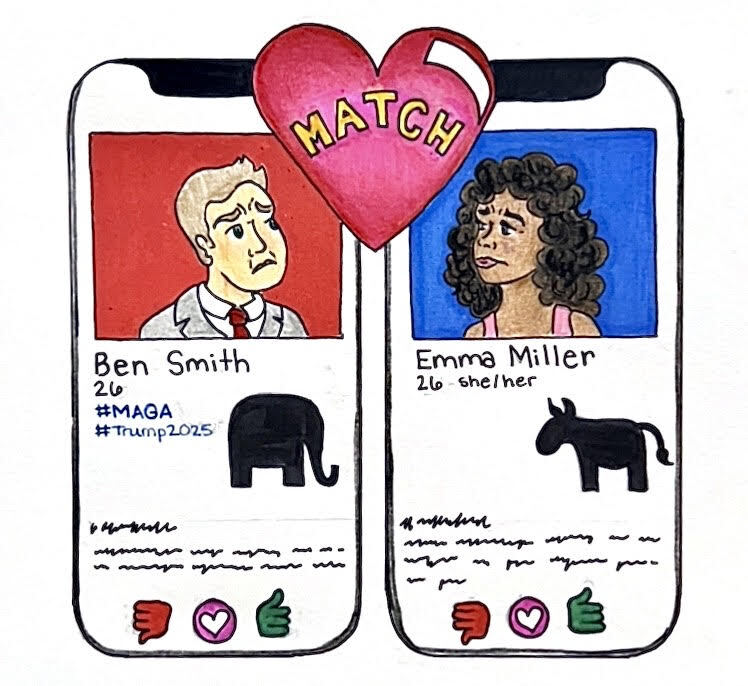
That uncomfortably dead time in my life forced me to think — and God was I doing some thinking — about all the ways Dad and I were different. He was a staunch Republican and I was quickly becoming more liberal. I was becoming more open-minded and he refused to accept that other perspectives could be valid. And perhaps most important: he was a white American man, born and raised in the not at all problematic state of Missouri, and I was a Black immigrant woman who only got to come to the states because my mother married my Dad. There were certain things that he would never understand.
Sometimes, when I don’t think about how close we used to be, I can escape the resentment I feel when I’m around him. When I go home for breaks, we barely speak. When he’s working on his boat, I help Mom in the house. When he’s in the house, I’m in my room. We have taken every measure to avoid each other. Not talking means no fighting, and no fighting means we don’t have to work through the uncomfortable sludge our relationship has been reduced to. Even when I’m at college, the only way I talk to my father is through my mother, who I try to remember to call every day.
A couple of years ago, after I had gotten in trouble for something unrelated, the argument escalated to where Dad asked me if I didn’t listen to him or respect him because he wasn’t my “real” father. Because he had adopted me. Of course not, I had said adamantly. He may have been my adopted father, but he was the father that had raised me and the only one I had ever known. But no matter how much I love my Dad, I know now what’s been true for a long time: I am not my father’s daughter anymore.