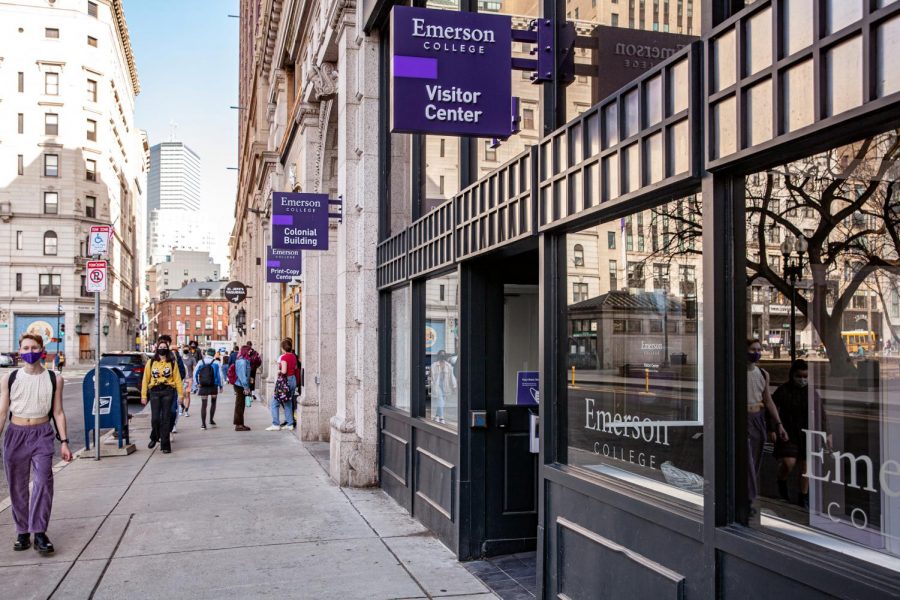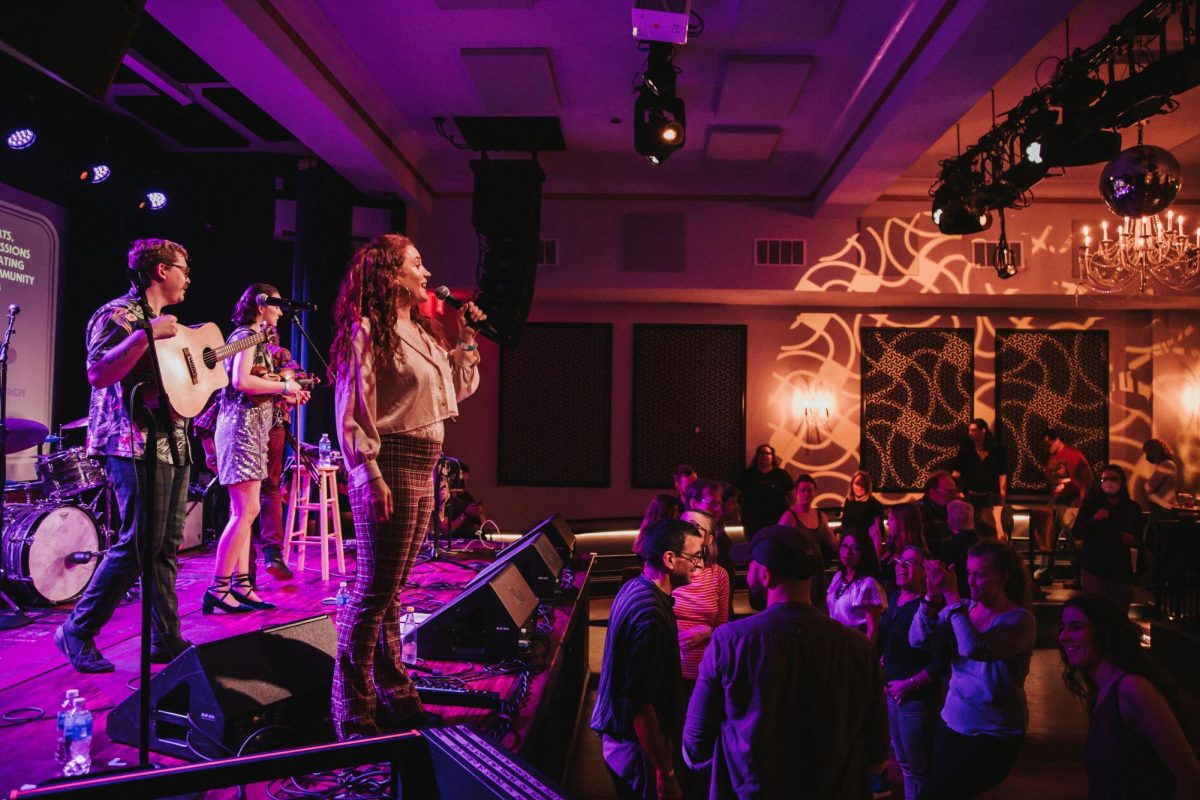



Dressed in fishnets and chunky black boots, at just 16 years old with her best friend by her side, now-senior Izzy Mitchell attended her first concert at a tiny music venue in New York City: a punk show for a band she had never heard of. Fans were crowd surfing above her, their own boots hitting the heads of audience members as they screamed the same lyrics in unison. Amid this chaos, the entire audience was connected by one thing: their love for the music.
“It’s an extreme example,” said Mitchell, now the program coordinator for Emerson College’s WERS 88.9 radio station. “But connection can even be [found in] things as small as everyone gathering in one spot and wearing the same clothes and screaming the same lyrics at the top of their lungs.”
Boston is an iconic college town, and is equally known as a city bustling with creativity, culture, art, and music. Many students come to the city for the possibility of connecting with a vibrant music community, whether they’re attending a music school like Berklee College of Music, playing shows around the city, or looking to become immersed in the city’s decades of music history. However, even in a city seemingly full of opportunities, it can still be difficult to know where to look. The realities of breaking into an industry like that of the Boston music scene are not easy.
“I think if I were just a fan, I wouldn’t be sure where to go,” said Isaiah Burke, a recent Berklee graduate and current contracted musician for Night Shift Entertainment, a Boston-based live music company. “I wouldn’t say it’s the most inaccessible because there’s definitely a passion for [music] here… but it can be hard to know where to find it.”
Burke shared that although there are some organized events like Boston Culture Nights or other gatherings and festivals around the area, there is no concrete network throughout the music scene in Boston. Having been a student at Berklee, he said he noticed that there was a lack of collaboration between the music students in the area and the rest of the city because there was no centralized way to stay connected.
“There are different groups that know each other, but there’s not a big sense of community,” Burke said. “I don’t think there are a lot of places where people can go that are centralized for these events.”
Even with the incredible potential for a thriving music scene in Boston, there are still barriers for connection between students, musicians, and music fans.
“I think there’s a lot of potential here for a really active and lively young arts scene,” Burke said. “There just kind of has to be some kind of bridge to, one, get the artists connected [to each other], and two, to get the artists connected to the audience.”
Riley Dekkers, an audio engineer at The Middle East Restaurant and Club music venue in Cambridge, shared similar sentiments about the lack of accessibility for students to the music scene in Boston. As a graduate from Berklee’s class of 2024, she noted that the Berklee music scene is “segregated” from the rest of Boston’s. She said that there’s a different music mindset for these two communities.
Outside of this Berklee-specific divide, Dekkers emphasized that there are very few places for students to play at, and for the ones that exist, it can be a financial strain to need to sell enough tickets to break even for a show.
“If you’re a student starting a band, there’s a select handful of above ground venues that are accessible,” Dekkers said.
According to Mitchell, beyond these barriers for entry, there is also an issue with the city’s outlook towards the music scene’s potential. As Mitchell highlighted, even in a city with an extensive music history – from the 144-year-old Boston Symphony Orchestra to bands like Aerosmith and the Pixies coming out of the later 20th century – the music community in Boston is often thought of as outdated.
“When people think of Boston music culture, they tend to think in the past tense,” Mitchell said. “Which is interesting to me because everyone will always say ‘there was a bustling jazz scene,’ and it’s like, no there still is, but instead of going to night clubs you have to look at the buskers on the corner.”
Despite this perception, Mitchell and Burke both noted that the music scene is, contrary to what some might believe, constantly evolving. They say that it has become a mix of the old and the new.
Reflecting on his experiences at two different music schools, one with a classical focus and one more contemporary take on a music education, Burke explained how the music culture at Berklee, like that in the broader Boston area, is young and open to change.
“There were a lot more people open to different ideas, or trying to push boundaries a little more,” Burke said.
Beyond Berklee, the Boston music community, as Emerson freshman, singer and songwriter Sophia Regina described, feels “alive and young.” From the busking scene on Newbury street to students rolling drum sets down to Boston Common to perform in the park, the musical landscape is still thriving.
For young musicians, breaking into this industry–especially when it comes to self-promotion, marketing, and trying to appeal to a social media algorithm–can be “daunting,” Regina said. However, getting started early is vital to making connections and getting your foot in the door, regardless of these obstacles.
“Just put a band together and play, if you wait too long you’ll miss the window where everyone made their friends,” Dekkers said. “You don’t need to be a perfectionist about it.”
Perfectionism can also be a limitation when it comes to people’s understanding of what success in the music industry looks like.
“A lot of people think that as a musician you’re either gigging or you’re touring or you’re super famous and that’s kind of it,” Burke said. ”[But] there are so many different pathways to success or financial stability in the music industry.”
And Mitchell said breaking into the industry doesn’t necessarily require following a set path or having a certain amount of experience either. As she put it, everyone has to build their own career “from the ground up.”
“No matter where you’re coming from, whether you’re coming from college, whether you’re coming from a 9-5, or if you’re coming from dropping your kids off at school, everyone’s kind of on an even playing field,” Mitchell said. “At the end of the day your music is either good or it’s not.”
Ultimately, as Dekkers and Mitchell both described, everything about getting into the music industry comes down to networking and connections.
“Focus on the community aspect of it, that’s how you break into the scene,” Dekkers said. “You hang out and share your art with each other, or you go see art. Everyone’s there just trying to hang out and socialize and connect.”
Burke noted that even with a college degree, the network at Berklee was the most important takeaway from his education.
“There’s a lot of people who are super invested in the arts, so I think my network has expanded,” Burke said.
Moreover, beyond the range of career paths in the performance side of the music industry, there are also ways to stay involved with the scene as a listener. As Mitchell discussed, the WERS radio station often features local student bands and provides a platform for students to get their music to the general public.
“A lot of the time people will ask to play [on our show],” Mitchell said. “People send us their music which is nice. We kind of have a bin that we sort through with CDs and stuff. The people who are looking will find us, and we’ll find the musicians in a cyclical manner.”
For Mitchell, radio serves as a tool to connect local artists and listeners in the Boston music scene.
“You could plug your phone into the aux… but there are still people who get into their car and turn on the radio instead,” Mitchell said.
She said that in doing so, radio fosters personal community connections that don’t exist elsewhere.
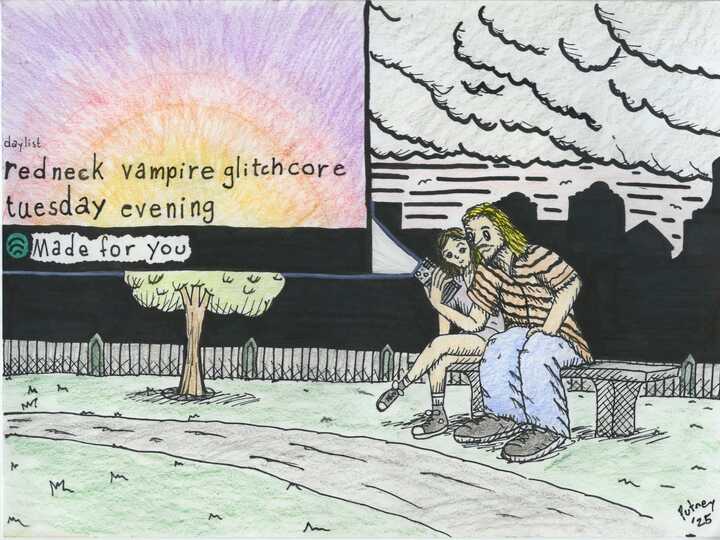
“What they’re looking for isn’t necessarily a curated list of music,” Mitchell said. “They’re looking for that piece of connection, of belonging, of community, in a way that Spotify’s DJ X might not be able to.”
And the feeling of the music that comes from Boston musicians is in itself a tool of connection that exists among Boston’s music community. As a musician herself, Mitchell described New England music as feeling “nostalgic” and carrying a weight of “restlessness,” as if you can feel the musician’s emotional “walls” through their lyricism.
Regardless of the obstacles that exist for young aspiring musicians–whether it be finding venues at which to perform, promoting oneself, or networking with others in the industry–there is still value in the Boston music scene.
“Being in a city in general, you just find more connections with more people you might not know,” Berklee freshman Sophi Zizzo said. “Being able to connect with people who have the same passion as you, it’s something to talk about.”
As Regina said, the love for music in Boston makes it a “close community.” From the distinct sound and feeling of Boston music to the city full of young musicians willing to busk on Newbury Street and beyond, the Boston music scene is still alive due to the nature of creativity and art itself.
“It’s everywhere here; everyone’s a creative,” Regina said. “Arts kids are more vulnerable… they’re open to being open.”